1 The Edge — why it works
A shakeout flushes weak holders right before the markup
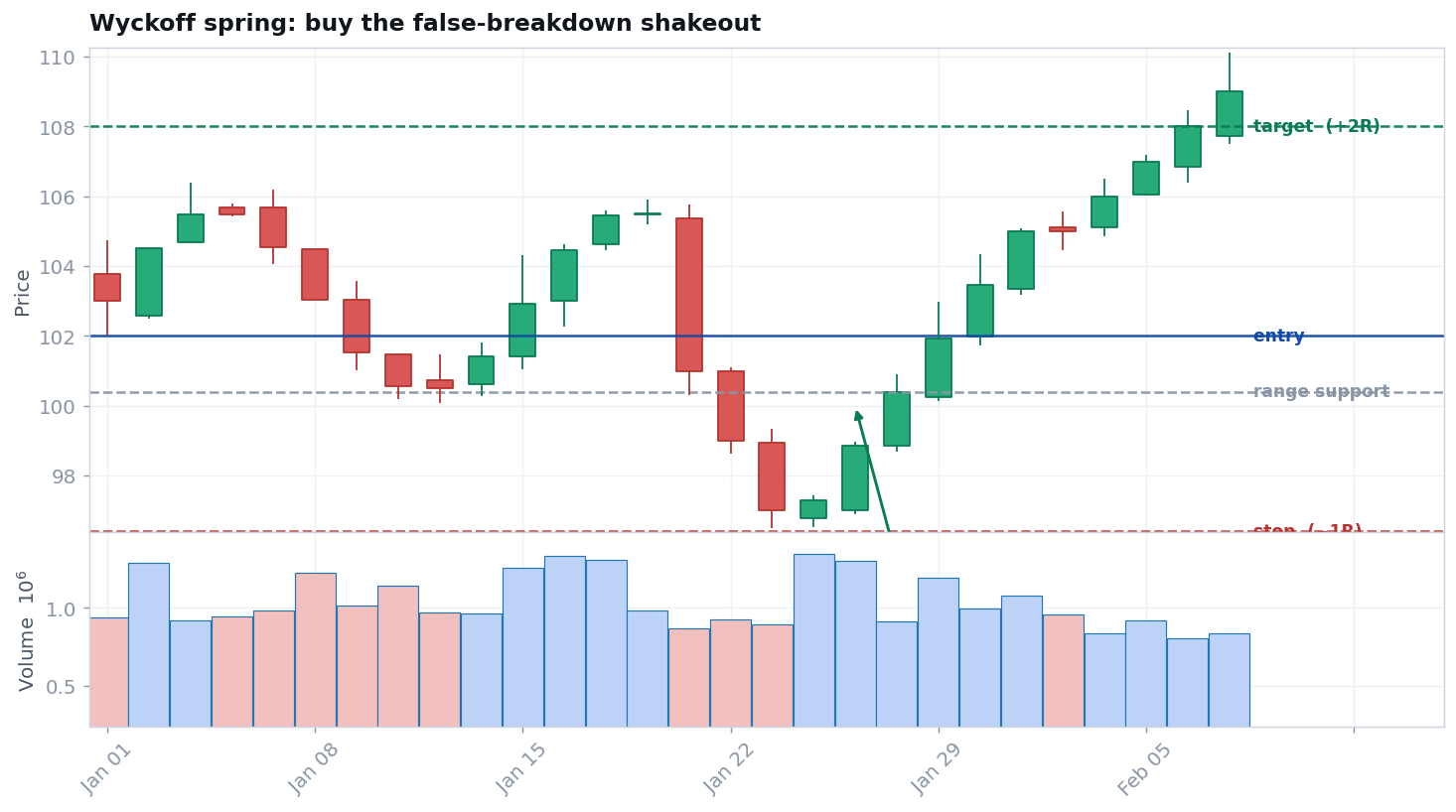
Near the end of a Wyckoff accumulation range, price briefly drops below support — tripping stops and scaring out weak holders — then snaps back inside. That false breakdown is the spring: the large operator scooping the cheap shares it just flushed out before driving price up.
Your edge is location and asymmetry: you buy as price reclaims support, with a stop just below the spring's low (small risk), targeting the top of the range or beyond (larger reward). Most failed springs cost you ~1R; the ones that work can pay several.
2 Where it works — and doesn't
Conditions matter more than the pattern
Works best when…
- A clear accumulation range after a downtrend (climax, automatic rally, secondary test).
- The dip below support reverses quickly and closes back inside.
- Down-volume on the spring fails to produce more downside (effort vs. result).
- The broader market isn't in free-fall.
Fails / avoid when…
- No prior range — price is just trending down (you're catching a knife).
- Price breaks down and stays down on heavy volume (real breakdown, not a spring).
- The 'spring' drifts lower for days instead of snapping back.
- Choppy, illiquid names where every level is noise.
3 Setup checklist
All true before you act
- ✓A defined accumulation range. Support and resistance are obvious, after a clear prior decline.
- ✓A spring below support. Price pokes under the range low and reverses back inside, ideally fast.
- ✓Effort vs. result confirms. The down-move shows volume but fails to follow through — supply is being absorbed.
- ✓A reclaim to enter on. Price closes back above support, giving a defined trigger and a stop just below the spring low.
4 The process
From signal to managed trade
Entry
Buy as price reclaims support after the spring (a close back inside the range). Confirmation first — don't try to catch the exact low.
Stop (1R)
Place the stop just below the spring's low — if price returns there, the spring failed. That distance is your 1R.
Position size
Risk a small fixed % of the account; the tight stop means a spring often gives a small 1R and an attractive reward-to-risk.
Exit & management
Target the top of the range (the prior resistance) or a measured move beyond it; trail the stop up under higher lows as the markup develops. Cut fast if support breaks again.
5 Worked example (illustrative)
One trade, start to finish, in R
| Account / risk per trade | $25,000 · 1% = $250 |
| Entry (reclaim of support) | $48.20 |
| Stop (below spring low) — 1R | $46.70 · 1R = $1.50/share |
| Position size = $250 ÷ $1.50 | ≈ 166 shares |
| Target (range top, +3R) | $52.70 |
| If it works: +3R | + $747 (≈ +3.0%) |
| If it fails: −1R | − $249 (≈ −1.0%) |
6 Honest expectancy
Why a tight stop carries the edge
The spring's appeal is the small, well-defined risk: you're wrong quickly if support breaks again, but right trades can run the height of the range. A moderate win rate with reward bigger than risk is what makes it work.
Example: win 45% at +3R, lose 55% at −1R → (0.45 × 3) − (0.55 × 1) = +0.8R per trade. Positive — but only over many trades, and springs are subjective to spot. This is an expectation, never a guarantee.
7 Make it yours
Test before you trade
A no-risk validation routine
Scroll back through dozens of charts that formed a range after a downtrend. Mark each apparent spring, the reclaim entry, the stop below the low, and the range-top target — before revealing what happened. Record each result in R, tally your win rate and average R, and compute the expectancy above. Journal every one — process over outcome.
8 Common mistakes
How traders blow this up
- Catching the knife. Buying the dip below support before it reclaims — there's no spring until price comes back.
- Ignoring follow-through volume. A breakdown that keeps going on heavy volume is a real breakdown, not a spring.
- Stop too tight. Placing the stop inside the spring's noise and getting shaken out.
- No range. Forcing the setup on a chart that never built an accumulation range.
- Oversizing. The tight stop tempts huge size; one failed spring at 5% risk still hurts.