1 The Edge — why it works
Stage 2 is where the biggest, most reliable gains happen
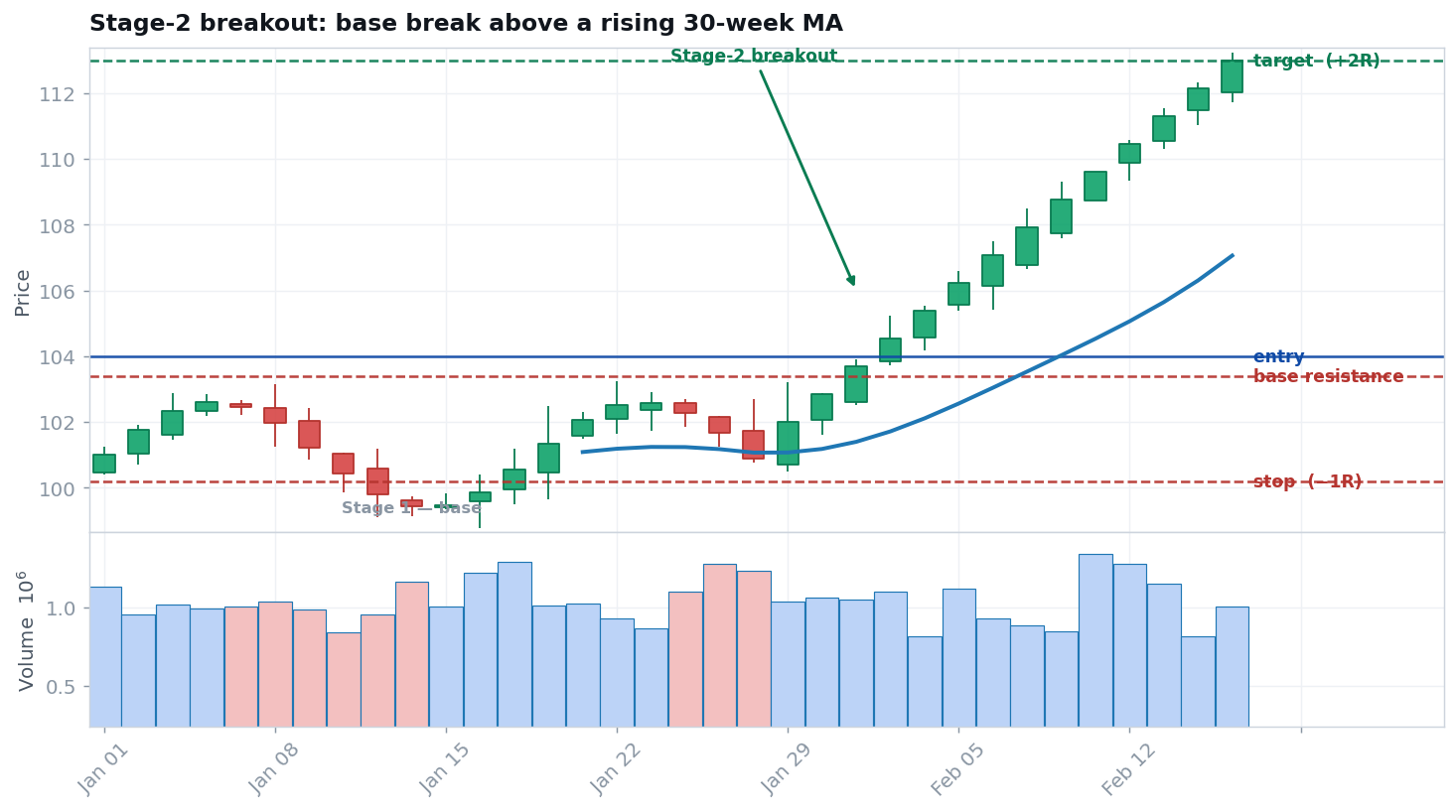
Weinstein's stage analysis splits a stock's life into four stages. A stock basing in Stage 1 that breaks above its range while the 30-week moving average turns up is entering Stage 2 — markup. Buying that transition puts you in the trend at its start, with a clear stage-based exit when it tops.
The stage filter does something powerful: it keeps you out of Stage-4 declines (falling knives) and only buys confirmed strength above a rising long-term average.
★ Anatomy of the entry
What a Stage-2 breakout looks like
2 Where it works — and doesn't
Conditions matter more than the pattern
Works best when…
- A clear Stage-1 base after a prior decline.
- The 30-week MA is flattening and turning up.
- The breakout comes on a surge of volume.
- Strong relative strength versus the market.
Fails / avoid when…
- A stock below a falling 30-week MA (Stage 4) — never buy it.
- A breakout on weak volume.
- Price already extended far above the MA (you're late).
- A weak overall market dragging everything down.
3 Setup checklist
All true before you act
- ✓A Stage-1 base. Sideways action after a decline, with a flattening 30-week MA.
- ✓A rising long-term average. The 30-week MA has turned up — strength is building.
- ✓A breakout on volume. Price clears the base resistance on clearly expanded volume.
- ✓Relative strength. The stock is leading, not lagging, the broader market.
4 The process
From signal to managed trade
Entry
Buy the breakout above the base into Stage 2 — price clearing resistance above a rising 30-week MA, on volume.
Stop (1R)
Below the base / breakout level (or below the 30-week MA). Entry − stop = 1R.
Position size
Risk a small fixed % of the account; shares = risk ÷ 1R.
Exit & manage
Hold the Stage-2 trend, trailing under higher lows. Exit when it rolls into a Stage-3 top or breaks below the 30-week MA into Stage 4.
5 Worked example (illustrative)
One trade, start to finish, in R
| Account / risk per trade | $25,000 · 1% = $250 |
| Entry (Stage-2 breakout) | $51.00 |
| Stop (below the base) — 1R | $46.50 · 1R = $4.50/share |
| Position size = $250 ÷ $4.50 | ≈ 55 shares |
| Stage-2 trend runs to +3R | $64.50 |
| If it works: +3R | + $742 (≈ +3.0%) |
| If it fails: −1R | − $247 (≈ −1.0%) |
6 Honest expectancy
Fewer, higher-quality position trades
Stage 2 trades are less frequent but higher-conviction: you only buy confirmed strength above a rising long-term average, and the winners are full trend moves.
Example: win 45% at +3R, lose 55% at −1R → (0.45 × 3) − (0.55 × 1) = +0.8R per trade. The stage filter's real value is avoiding the Stage-4 losers entirely. An expectation, never a guarantee.
7 Make it yours
Test before you trade
A no-risk validation routine
Add a 30-week (≈150-day) moving average to charts and scroll history. For past big winners, mark the Stage-1 base, the Stage-2 breakout entry, the below-base stop, and how far the trend ran in R — before checking the outcome. Note how often a Stage-4 filter would have kept you out of disasters.
8 Common mistakes
How traders blow this up
- Buying in Stage 1 or 4. Too early (no trend yet) or a falling knife (downtrend) — wait for Stage 2.
- Ignoring the MA slope. A breakout above a falling MA isn't Stage 2.
- No volume. Stage-2 breakouts need participation to be trustworthy.
- Chasing extension. Buying far above the MA gives a huge stop and poor reward/risk.
- Selling the winner early. Stage 2 can last a long time — let the markup run.