Overview
Order flow is the live stream of buy and sell orders hitting the market. Tape reading is the skill of interpreting it — the executed trades and the resting orders — to judge who is in control right now. It is the most granular read of supply and demand there is, the layer beneath the chart.
Two data feeds matter: the tape (time & sales — every trade that actually happened) and the order book (Level 2 / DOM — the resting bids and offers waiting at each price).
Origins & history
- Early 1900sTape reading is the original form of active trading — Jesse Livermore and Richard Wyckoff made fortunes reading the ticker tape long before charts were common.
- ModernThe ticker tape became the electronic Time & Sales window, the Level 2 book, the depth-of-market ladder (DOM), and today's footprint / cluster charts.
How it works
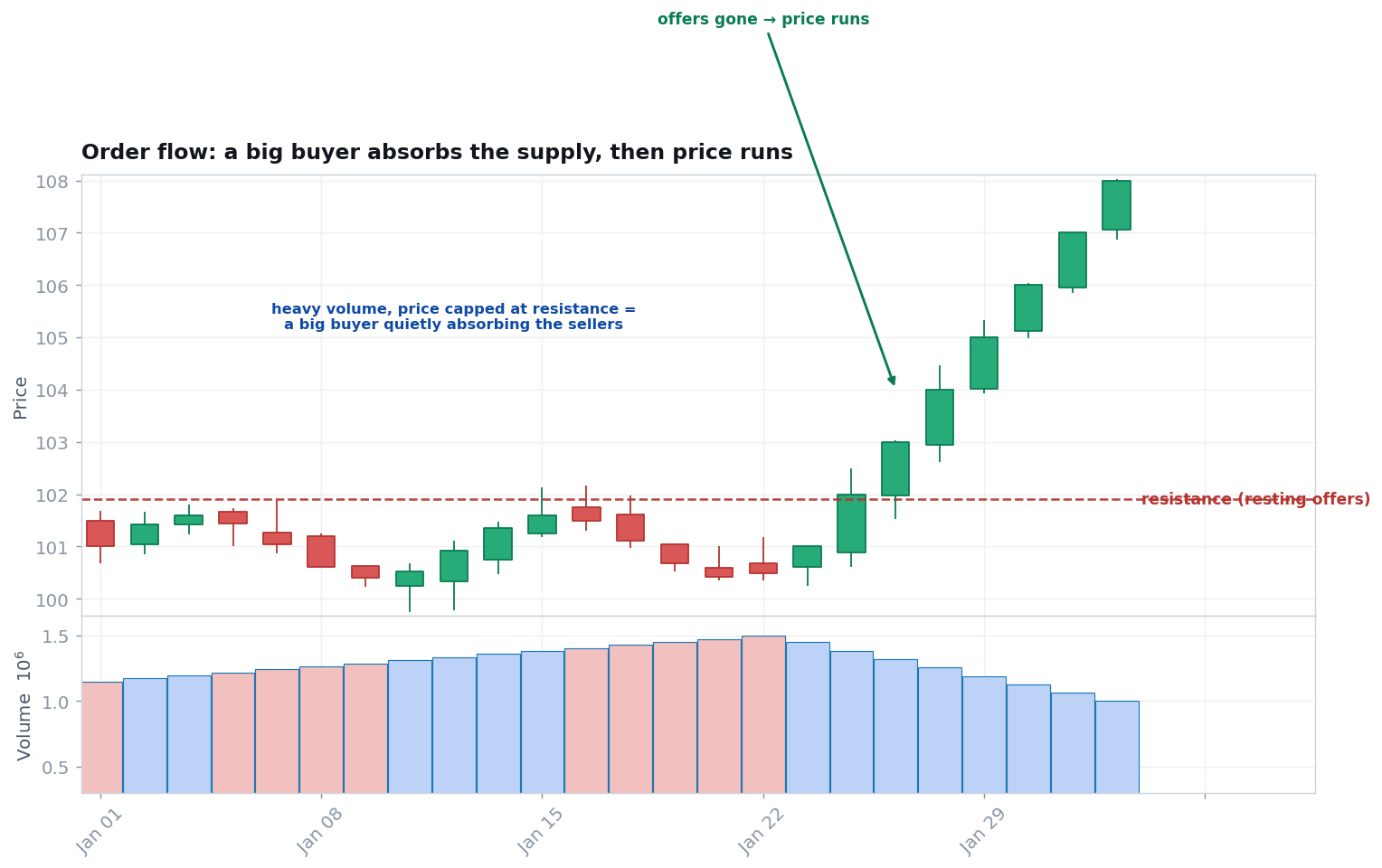
Two distinct reads:
- ·The tape = executions. Every completed trade, with size, and whether it hit the bid or lifted the offer — committed capital, real conviction.
- ·The book = intentions. Resting limit orders stacked at each price (DOM) — potential support and supply, but only intentions until filled.
- ·Aggression. Prints at the offer = aggressive buyers; prints at the bid = aggressive sellers. That imbalance is the core signal.
- ·Absorption. Heavy volume with little price movement means a large resting order is soaking up the aggression — often just before a turn (Wyckoff again).
Market psychology & mechanics
Buyers and sellers are always equal in number — what order flow reveals is urgency. When buyers repeatedly pay up to lift offers, they're telling you they fear missing out more than they fear overpaying. Large players, who can't hide their size on a chart, often try to hide it in the flow — resting hidden "iceberg" orders or, illegally, flashing fake size to mislead (spoofing). Reading the tape is reading that psychological battle in real time.
Honest assessment
Strengths
It is the most immediate, granular read available — it can reveal absorption and exhaustion before they show on the chart, and it is the foundation of execution, scalping, and VWAP work.
The evidence
Market-microstructure research is clear that informed order flow carries information and helps drive short-term price (order-flow imbalance has genuine predictive content). But the edge is hardest to capture where it is most studied — the domain of fast, well-capitalised players and algorithms.
Evidence rating: real and important at the microstructure level; very difficult for retail to exploit reliably.
Weaknesses & failure modes
- HIDDENHalf the flow is invisible. Roughly 45–50%+ of US equity volume now trades off-exchange in dark pools and internalisers, so the public tape and book are fundamentally incomplete.1
- SPOOFThe book can lie. Resting orders can be fake (spoofing) or hidden (icebergs) — depth is not destiny.
- SPEEDIt's an HFT arena. The fastest, best-capitalised algorithms dominate the tape; retail reads it late.
- FXNo consolidated tape in FX. Decentralised markets have no single order flow to read.
Professional uses vs. retail misuses
How professionals use it
- Confirming absorption/exhaustion at key levels.
- Timing precise scalp entries and executions.
- Reading aggression alongside structure and volume — never alone.
Common retail misuses
- Trusting the visible book as the whole picture.
- Chasing every large print (it may be a spoof or a dark-pool echo).
- Trying to out-speed algorithms at their own game.
Going deeper
Tools: the DOM ladder, footprint / cluster charts, order-flow imbalance, cumulative delta, and dark-pool print trackers. Concepts: absorption, iceberg orders, spoofing, and the difference between liquidity-taking (aggressive) and liquidity-providing (passive) flow. Multi-timeframe: order flow times the entry; structure and trend decide whether to take it at all.
Practice
Quiz 1 — What's the difference between the tape and the order book?
The tape (time & sales) shows trades that actually executed — committed capital. The order book shows resting orders — intentions that may never fill, and can even be fake.
Quiz 2 — Prints keep hitting the offer (ask). What does that suggest?
Aggressive buying — buyers are willing to pay up to lift the offer, signalling urgency on the buy side.
Quiz 3 — Why is reading the public tape an incomplete picture today?
Because a large share of volume — roughly half of US equities — trades off-exchange in dark pools, invisible in the public feed until after the fact. What you see is only part of the real flow.
This concept in the knowledge graph
Resources
- TRADERJesse Livermore & Richard Wyckoff — the original tape readers.
- CONCEPTVolume & VWAP.
- GLOSSARYOrder flow, tape, order book, absorption.